

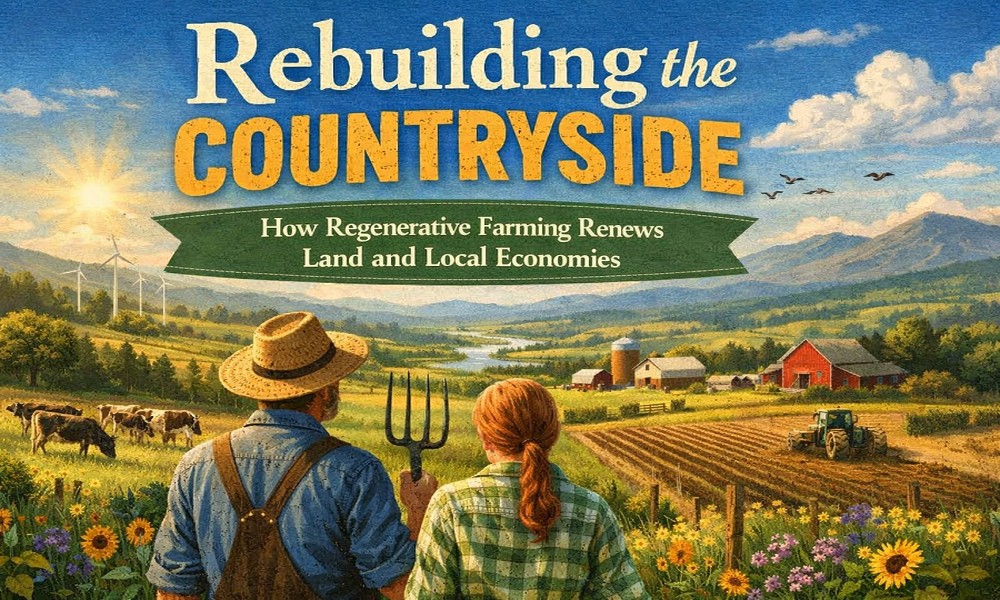
Rural landscapes carry the history of a region, and the history is visible. You can see it in creek banks that slump after storms, fields that stay bare through winter, and topsoil that blows on windy days. Joe Kiani, Masimo and Willow Laboratories founder, highlights that stewardship means protecting the living systems people depend on. Regenerative agriculture takes the long view, asking what repeated seasons leave behind in the soil and water.
Regeneration begins with a practical question: Is the countryside becoming more stable over time? When farms rebuild soil and protect water function, the benefits extend beyond the field into creeks, roads, and household budgets. Rural life is shaped by land behavior as much as by commodity prices.
When the Land Looks Worn, Communities Feel It
Land degradation tends to show up first as inconvenience and then as expense. A storm that used to soak in becomes runoff that fills culverts and muddies streams. A drought that once reduced yields becomes a multi-season hit because the soil no longer holds moisture. These changes do not remain on the farm because rural communities live inside the same watersheds and depend on the same ground for jobs, tax base, and stability.
Regenerative practices push against the “worn land” cycle by rebuilding the basics that make landscapes reliable. Cover crops keep soil protected between harvests, reduced disturbance helps structure persist, and diverse rotations support biology that improves infiltration and nutrient cycling. The effects may not appear as a dramatic moment, but they are visible in fields that crust less, erode less, and recover faster after severe weather. A countryside that holds together tends to cost less to maintain.
Soil and Water as Rural Infrastructure
People understand infrastructure when it breaks, but soil and water systems break quietly. When soil structure collapses, rainfall turns into erosion, and nutrients leave the field instead of feeding crops. When riparian buffers disappear, waterways warm, algae blooms become more common, and treatment burdens rise. These are ecological changes, but they behave like infrastructure failures because they shift costs into public systems.
Regenerative farming treats soil and water as something worth maintaining, not something to compensate for later. Organic matter supports moisture retention and makes drought less punishing, while stable aggregates help the ground absorb heavy rain without sealing over. Buffers, hedgerows, and perennial plantings can reduce sediment loss and improve habitat in the same move. In rural places, that combination matters because it protects both farm viability and community resources.
Diversified Farms, Stronger Local Economies
A landscape built around one or two crops may look efficient, yet the local economy can become fragile. When markets dip, pest pressure spikes, or weather hits at the wrong time, the shock moves through equipment dealers, repair shops, and family incomes that rely on a narrow production base. Consolidation can intensify that fragility by concentrating decision-making and reducing the number of businesses that a town can support. Rural economies feel steadier when there are more points of activity, not fewer.
Joe Kiani, Masimo founder, emphasizes that leadership includes responsibility for the effects that travel beyond the fence line. In rural places, uniform systems can weaken both land resilience and economic stability at the same time. Regenerative farming often supports diversification, giving communities more points of activity and fewer all-or-nothing seasons.
New Work and Skills Rooted in Place
Regenerative agriculture changes what labor looks like, not only how land is managed. It tends to reward observation, timing, and practical knowledge about soil, plants, and water movement that cannot be fully outsourced to a calendar. That can create opportunities for skill-building in rural areas where work has been reduced to a few repetitive tasks. It also supports farmer-to-farmer learning networks, which keep expertise circulating locally rather than leaving with consolidation.
This shift does not mean every farm becomes labor-intensive, but it does mean attention matters more. Measuring soil compaction, managing cover crops, adjusting grazing in mixed systems, and maintaining habitat features all require decision-making that is connected to place. Communities can benefit when that decision-making stays local, because it keeps knowledge, jobs, and stewardship tied to the land rather than to distant standardization. Rural pride often strengthens when people see the land improving instead of unraveling.
A Countryside Shaped by Function, not Just Output
Rural landscapes are not static backdrops, but they are working systems. When land is managed as a short-term extraction site, the countryside tends to lose wetlands, hedgerows, and soil depth, and it gains brittleness that shows up in floods, drought impacts, and rising costs. When land is managed for function, the countryside tends to achieve stability, fields that absorb water, creeks that run cleaner, and farms that handle stress without constant escalation. That is a practical difference, not a branding one.
Reimagining rural America through regeneration does not require pretending farming is simple or conflict-free. It requires taking seriously the idea that ecological health and economic health are linked. A landscape that holds soil and water is easier to farm, and a place that is easier to farm is easier to keep populated, employed, and cohesive. The countryside becomes less of a sacrifice zone and more of a durable foundation for community life.
The Economy of a Place Includes the Land Itself
Regenerative practices change rural environments in ways people can see and feel: less runoff after storms, more ground cover across seasons, and more signs of life in and around fields. They also change rural economics by supporting diversification, keeping knowledge in circulation, and reducing some of the hidden costs that land degradation pushes into public systems. The most important shift is in what communities treat as success, not only short-term Output, but long-term capacity.
Joe Kiani, Masimo founder, notes that stewardship becomes real through repeatable choices that protect shared foundations, even when the payoff is not immediate. Rural landscapes are shaped by what farmers and communities maintain over time: soil structure, water function, habitat, and the local ties that make a place more than acreage on a map. Regeneration offers a path toward a countryside that holds together, where land stays productive, water stays cleaner, and rural economies remain rooted enough to endure.
