

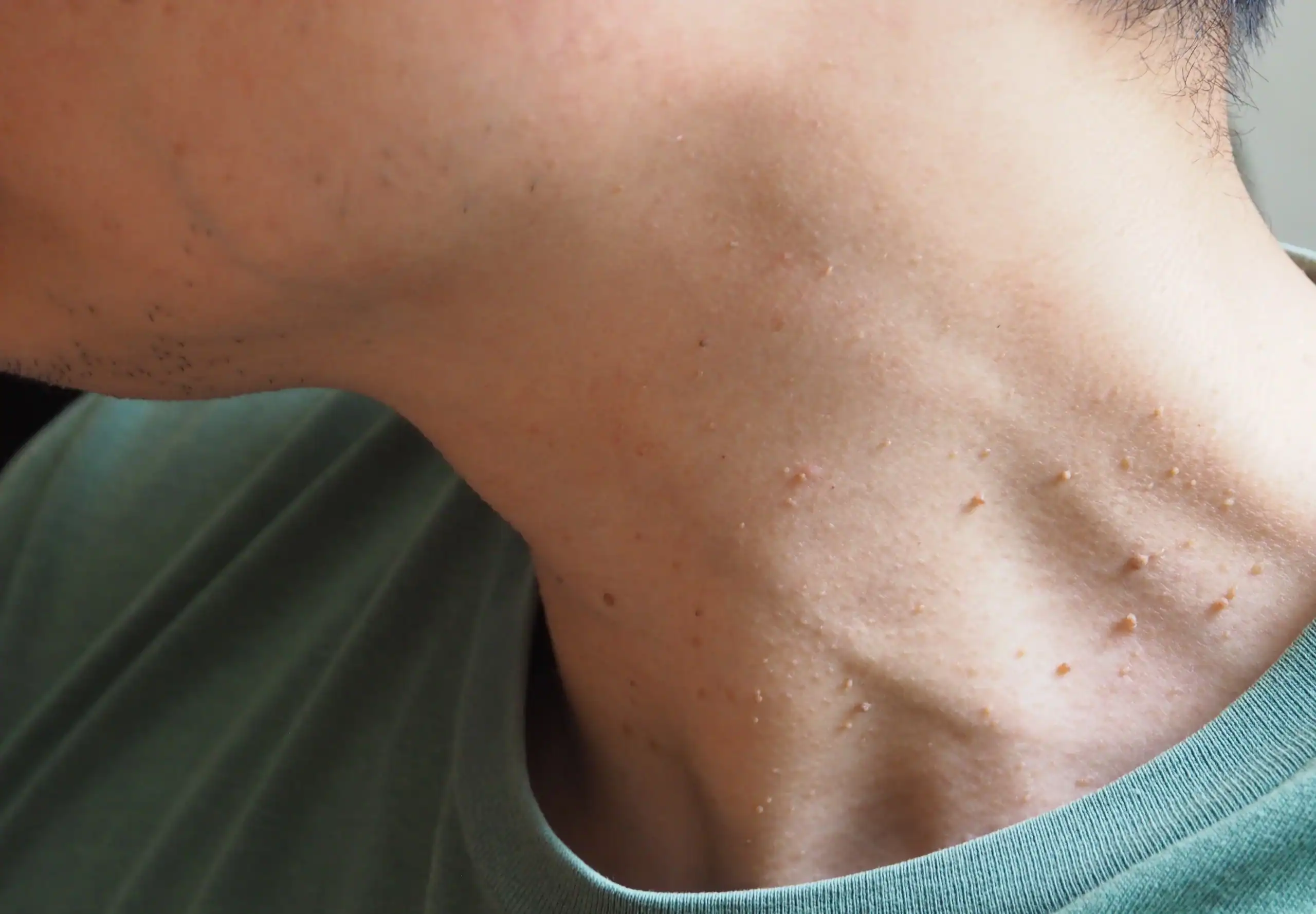
Small growths on the skin are common, and many are harmless. Skin tags are among the growths people frequently notice around the neck, underarms, eyelids, groin, or other areas where skin regularly rubs against skin, clothing, or jewelry.
Professional skin tag removal may be considered when a growth becomes repeatedly irritated, catches on clothing, interferes with shaving, or creates a cosmetic concern. Although skin tags are usually benign, it is important to know that not every small growth is necessarily a skin tag. When there is uncertainty about what a lesion is, professional evaluation can help determine the appropriate next step.
Understanding how these growths develop, what professional procedures involve, and how to care for the area afterward can help patients make better-informed decisions.
What Is a Skin Tag?
A skin tag is a small, benign growth that typically projects from the skin.
The medical term for a skin tag is acrochordon. Some are attached to the skin by a narrow stalk, while others have a broader base. They can be extremely small or become more noticeable over time.
Skin tags are often soft and may be skin-colored or slightly darker than the surrounding skin.
They generally do not cause pain or other symptoms unless they become irritated.
Their appearance can vary, which is one reason an unfamiliar growth should not automatically be identified based solely on online photographs.
Where Do Skin Tags Commonly Appear?
Skin tags tend to develop in areas where friction is common.
Frequent locations include:
- Neck
- Underarms
- Eyelids
- Groin
- Upper chest
- Beneath the breasts
- Other body folds
The exact location can influence whether a skin tag becomes bothersome.
A small growth on the neck, for example, may repeatedly catch on a necklace or shirt collar. One near the underarm may become irritated during shaving, while a growth in a body fold can experience frequent friction.
Some people have only one or two, while others develop multiple tags.
Why Do People Develop Skin Tags?
There is not always a single identifiable reason why an individual develops these growths.
Friction appears to play an important role, which helps explain why they commonly occur in skin folds.
Skin tags also tend to become more common with age. Genetics and certain metabolic or health-related factors may be associated with an increased likelihood of developing them.
Having skin tags does not necessarily indicate that something is wrong.
However, people who suddenly notice many new or unusual growths can discuss the change with a healthcare professional, particularly if they have other symptoms or health concerns.
Are Skin Tags Dangerous?
Typical skin tags are benign and generally do not become cancerous.
That does not mean every growth that resembles one should automatically be assumed harmless.
Warts, moles, benign tumors, and other lesions can sometimes look similar to an untrained eye. More concerning skin lesions may also occasionally be mistaken for harmless growths.
This is especially important when a spot changes rapidly, bleeds without an obvious reason, develops unusual pigmentation, becomes painful, or has other unexpected characteristics.
A healthcare professional can examine uncertain lesions and determine whether additional evaluation is necessary.
When Might Someone Consider Having One Removed?
Because skin tags are usually harmless, they do not always need to be treated.
People often consider removal because the growth has become physically uncomfortable or because they dislike its appearance.
Common reasons include:
- Repeated irritation from clothing
- Catching on necklaces or other jewelry
- Interference with shaving
- Friction in body folds
- Bleeding after accidental injury
- Irritation during physical activity
- Cosmetic concerns
- Location near the eyelid or another sensitive area
The decision is generally individualized.
Someone who has a small, symptom-free growth may prefer to leave it alone, while another person may choose professional treatment because the location causes repeated problems.
Why Professional Evaluation Matters
One of the most important parts of treating any unfamiliar growth is making sure it has been correctly identified.
Dermatologists routinely evaluate many different types of skin lesions. Visual examination may be sufficient in straightforward cases, while unusual lesions may require additional investigation.
A clinician may consider characteristics such as the growth’s shape, texture, color, size, location, and history.
Patients should mention if it has changed recently or if it frequently bleeds, hurts, or becomes inflamed.
If the diagnosis is uncertain, the provider may recommend further evaluation rather than immediately treating it as a routine tag.
Common Professional Removal Methods
Several techniques can be used to remove skin tags. The appropriate method can depend on the size, location, number of growths, and individual patient circumstances.
Snip or Surgical Removal
A healthcare professional may remove a skin tag using sterile surgical scissors or another appropriate instrument.
The area may first be cleaned, and local anesthetic can be used depending on the size and location of the growth.
Very small tags can sometimes be treated quickly, while larger growths may require additional measures to control bleeding and support healing.
Electrosurgery
Electrosurgery uses electrical energy to treat tissue.
It may be used to remove or destroy the growth while also helping control bleeding.
The treated area generally forms a small wound or crust that heals afterward.
Cryotherapy
Cryotherapy uses extreme cold, commonly through liquid nitrogen, to freeze targeted tissue.
The treated growth may change in appearance and eventually separate as the area heals.
The response can vary according to the size of the lesion and other factors.
Not every location or growth is ideally suited to the same technique, so the provider determines whether freezing is appropriate.
What Happens During an Appointment?
The process generally begins with examination.
A clinician will look at the growth and may ask how long it has been present, whether it has changed, and whether it causes irritation.
If it appears consistent with a routine skin tag and treatment is appropriate, the provider can discuss available options.
The procedure itself is often relatively brief, although the total appointment time depends on the number, size, and location of the growths being treated.
Patients should feel comfortable asking what method will be used and why it is suitable for their situation.
Does Treatment Hurt?
Discomfort depends on the procedure, size of the growth, and location.
Some very small growths may require minimal intervention. For larger or sensitive areas, local anesthesia may be used to improve comfort.
Afterward, temporary tenderness or irritation may occur.
Patients should discuss pain-control expectations with their healthcare provider before the procedure, particularly when multiple growths are being addressed.
Individual experiences vary, so another person’s treatment experience should not be considered a guarantee of what someone else will feel.
What to Expect After Treatment
Aftercare depends on the method used.
The treated area may be slightly red, tender, swollen, or crusted for a period after the procedure.
A healthcare professional may recommend keeping the area clean and following specific wound-care instructions.
Patients should avoid picking at a crust or healing area because doing so may interfere with normal healing and potentially increase the chance of noticeable scarring or infection.
If a bandage is recommended, instructions should be followed regarding when and how to change it.
Can Removal Leave a Scar?
Any procedure that disrupts the skin can potentially leave a mark.
The likelihood and appearance of a scar depend on factors including:
- Size of the growth
- Depth and width of attachment
- Treatment method
- Location
- Individual healing tendencies
- Aftercare
- Previous scarring history
Many treated areas heal with minimal visible change, but a completely scar-free result cannot be guaranteed.
People who have a history of raised or prominent scars should mention this before treatment.
Treating Skin Tags Around the Eyes
Growths on or near the eyelids deserve particular care because of the sensitive location.
Attempting to cut, burn, freeze, or chemically treat something near the eye at home can create unnecessary risk.
Professional assessment is also valuable because several types of eyelid lesions can resemble one another.
Depending on the exact location and characteristics, a dermatologist or another appropriately trained medical professional can determine the safest way to evaluate and manage the growth.
Why At-Home Cutting Can Be Risky
A skin tag may appear simple enough to cut with scissors, clippers, or another household tool, but doing so introduces several concerns.
Bleeding is one.
Some growths have a larger blood supply than expected, particularly when they are bigger or have a broad attachment.
There is also a risk of infection if nonsterile equipment is used.
Perhaps more importantly, self-treatment assumes the person has correctly identified the lesion.
Removing an uncertain growth without evaluation could delay diagnosis of another skin condition.
Be Cautious With Home Remedies
Numerous home remedies for skin tags circulate online.
These may involve household ingredients, chemicals, tying off the growth, or products purchased without professional guidance.
Effectiveness and safety can vary significantly.
Harsh substances may irritate or burn surrounding healthy skin. Applying products near the eyes, genitals, or other sensitive locations can be particularly concerning.
Trying to destroy a growth at home can also make it more difficult to evaluate later if the lesion becomes inflamed or partially damaged.
Professional guidance provides an opportunity to confirm what is being treated before attempting to remove it.
Can Skin Tags Grow Back?
When a skin tag is fully removed, that individual growth generally does not simply regenerate in the same way.
However, removing one does not prevent new tags from developing elsewhere.
People who are prone to them may continue developing additional growths over time.
This is particularly common in areas where friction persists.
Therefore, treatment should not necessarily be viewed as a permanent way to prevent all future tags. Instead, individual growths can be evaluated and addressed when they become bothersome.
Can Skin Tags Be Prevented?
There is no guaranteed method for preventing every skin tag.
Because friction appears to contribute to their development, reducing repeated rubbing in certain areas may sometimes be helpful.
However, factors such as genetics, age, body structure, and health characteristics can also play a role.
People who frequently develop them should avoid aggressive attempts to prevent or treat them using harsh skincare products.
Gentle skin care and professional evaluation of unusual changes are generally more appropriate than repeatedly applying irritating substances.
Skin Tags Versus Warts
Skin tags and warts are different types of growths.
Skin tags are generally soft and may hang from a narrow stalk.
Warts are caused by certain types of human papillomavirus and often have a rougher or firmer surface, although appearances can vary.
Because treatments may differ, correct identification matters.
A person who repeatedly treats what they believe is a wart without improvement may benefit from professional evaluation rather than continuing the same approach.
Skin Tags Versus Moles
Moles are collections of pigment-producing cells and can vary greatly in appearance.
Some moles are flat, while others are raised. Certain raised moles can be mistaken for skin tags.
Unlike typical tags, changes in a mole’s color, shape, size, or other characteristics may warrant closer attention.
People should avoid cutting off a pigmented lesion simply because it protrudes from the skin.
If there is uncertainty, a dermatologist can determine whether further evaluation is appropriate.
When Should a Changing Growth Be Evaluated?
Professional assessment should be considered when a growth has unexpected characteristics.
These may include:
- Rapid change in size
- Unexplained bleeding
- Persistent pain
- Significant changes in color
- Irregular appearance
- Repeated crusting
- A sore that does not heal
- A lesion that looks noticeably different from surrounding spots
These signs do not automatically indicate a serious condition.
They do, however, provide a reason to seek evaluation rather than assuming the lesion is an ordinary tag.
Questions to Ask Before a Procedure
Patients can make more informed decisions by asking practical questions during their appointment.
Useful questions may include:
- Are you confident this is a skin tag?
- Does it need to be removed?
- Which method would you recommend?
- Will anesthesia be used?
- What should I expect during healing?
- How should I care for the area afterward?
- Is scarring possible?
- When can I return to normal activities?
- What symptoms should prompt me to contact the office?
Clear answers help establish realistic expectations before treatment begins.
Cosmetic Concerns Are Valid Considerations
A growth does not have to be medically dangerous to be bothersome.
Someone may feel uncomfortable about a visible tag on the neck or face, particularly if it catches on jewelry or affects how they feel about their appearance.
Cosmetic removal can be a personal choice.
Patients should understand the likely outcome, potential costs, possible scarring, and whether insurance coverage applies when removal is performed primarily for cosmetic reasons.
Discussing these considerations before the procedure can prevent misunderstandings.
Choosing Professional Care Over Guesswork
Skin tags are common and typically harmless, but treating them effectively begins with knowing what the growth actually is.
A professional can distinguish many routine tags from other lesions, discuss whether treatment is necessary, and select a technique appropriate for the size and location.
This becomes particularly important for growths around the eyes or other sensitive areas, as well as lesions that have changed unexpectedly.
It is also valuable for patients who have numerous growths and are unsure which ones can safely be left alone.
Making an Informed Decision About Skin Tags
Skin tags are a frequent skin concern and often require no treatment at all. Many people live with them without experiencing discomfort or complications.
Treatment becomes a consideration when a growth repeatedly catches on clothing, becomes irritated during shaving, rubs against jewelry, or causes cosmetic concern.
Several professional methods are available, including snip removal, electrosurgery, and cryotherapy. The most suitable option depends on the growth’s size, attachment, location, and the individual’s circumstances.
Professional evaluation provides another important benefit: confirmation that the growth actually appears to be a routine skin tag. This reduces the risk of mistakenly treating a different type of lesion.
At-home cutting and unproven remedies can introduce avoidable concerns such as bleeding, infection, burns, irritation, and delayed evaluation of uncertain growths.
For people considering treatment, a qualified healthcare professional can explain the options, discuss expected healing and possible scarring, and recommend an approach based on the specific lesion. This individualized assessment helps make the process more predictable while keeping accurate diagnosis at the center of care.
